|
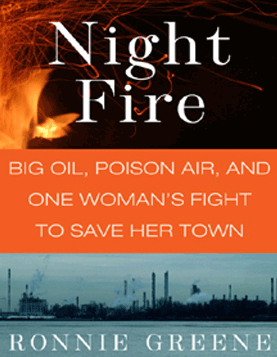 |
Based on: "Night Fire: Big Oil, Poison Air, And Margie Richard's Fight To Save Her Town" by Ronnie Greene
The black townsfolk of Diamond, Louisiana are church-going, hard-working, honest people. They are also sick, dying, injured by explosions and fires. Living on a former plantation in the shadow of a Shell Oil refinery, helplessness consumes their hope. When Peace Core worker and Louisiana native, Ann Rolfes, brings forward her stories of Shell’s shocking abuses in Nigeria — she and Diamond resident Margie Richard join forces to bring Diamond’s story to an international platform and stand up against the corporation and its environmental crimes.
After years of mysterious fires and neighbors falling sick and dying, Margie Richard, a retired Louisiana schoolteacher, took matters into her own hands. She led a lengthy battle against the pair of Shell petrochemical plants that bookend the African-American community of Diamond in Norco, a small town upriver of New Orleans amid the toxic skein of industry dubbed Cancer Alley.
Shell wasn’t just a health menace; it was the town’s main employer, and community support largely broke along racial lines.
Anne Rolfes, a fellow Louisianan, goes to Nigeria with the Peace Corps and bears witness to Shell’s stranglehold on the area and the government’s complicity in its horrors. Members of he native Ogoni tribe are pushed out and those who speak for them are shot at, abused and jailed. As the Peace Corps pulls out the increasingly dangerous area, Anne Rolfes is inspired to act. She writes “The Passport Book” which indicts Shell for its activities in Nigeria.
Anne’s efforts fall on deaf ears back in America, but she is lead to Margie, whose fight against Shell has grown strong. With a steely mix of faith and ingenuity, Richard led a grass roots effort, setting up a Web cam to broadcast illegal venting of toxic chemicals, and distributing buckets to the community to install their own atmospheric monitors. When she realized there wasn’t enough power in Diamond to turn around a huge multinational corporation, she traveled to Nigeria to view the hardships suffered by the Ogoni people in the Niger delta around the Royal Dutch / Shell plants. Working with a coalition of activists, she traveled to climate treaty negotiations being held at The Hague in the Netherlands. Accompanied by a documentary film crew, she invited Shell company executives to take a breath of Norco’s air and drink the polluted water sample she took in Lagos. Two weeks later, a top Shell executive from London was knocking on her trailer door in Diamond.
After a period of twelve years of organizing (1990-2002), Margie’s efforts succeeded when Shell agreed to invest more than $20 million in emission reduction and paid a minimum of $80,000 to each homeowner in a four-block area near the plants in Diamond — an offer everybody accepted. This was a historic victory for fence-line communities in the U.S. (predominantly impoverished and African-American). In 2004 Richard became the first African American to win the $125,000 Goldman Environmental Prize.
Back to Films |